
Industry Insights
Corporate Uniform Supplier Checklist for Procurement Teams
Use this practical checklist to compare uniform suppliers, align garment specifications, approve samples, plan repeat orders, and confirm delivery terms.
Choosing a corporate uniform supplier is a multi-step sourcing decision. Procurement, HR and operations teams need to align garment requirements, branding, sizing, delivery and repeat orders across roles or locations. A short, documented review helps each stakeholder compare suppliers on the same basis.
Use the questions below before requesting a quote or approving a production sample.
At a glance
Confirmed terms for GAZO projects
Bulk production timing, project pricing and fabric availability are confirmed in the project quotation.
The process at a glance
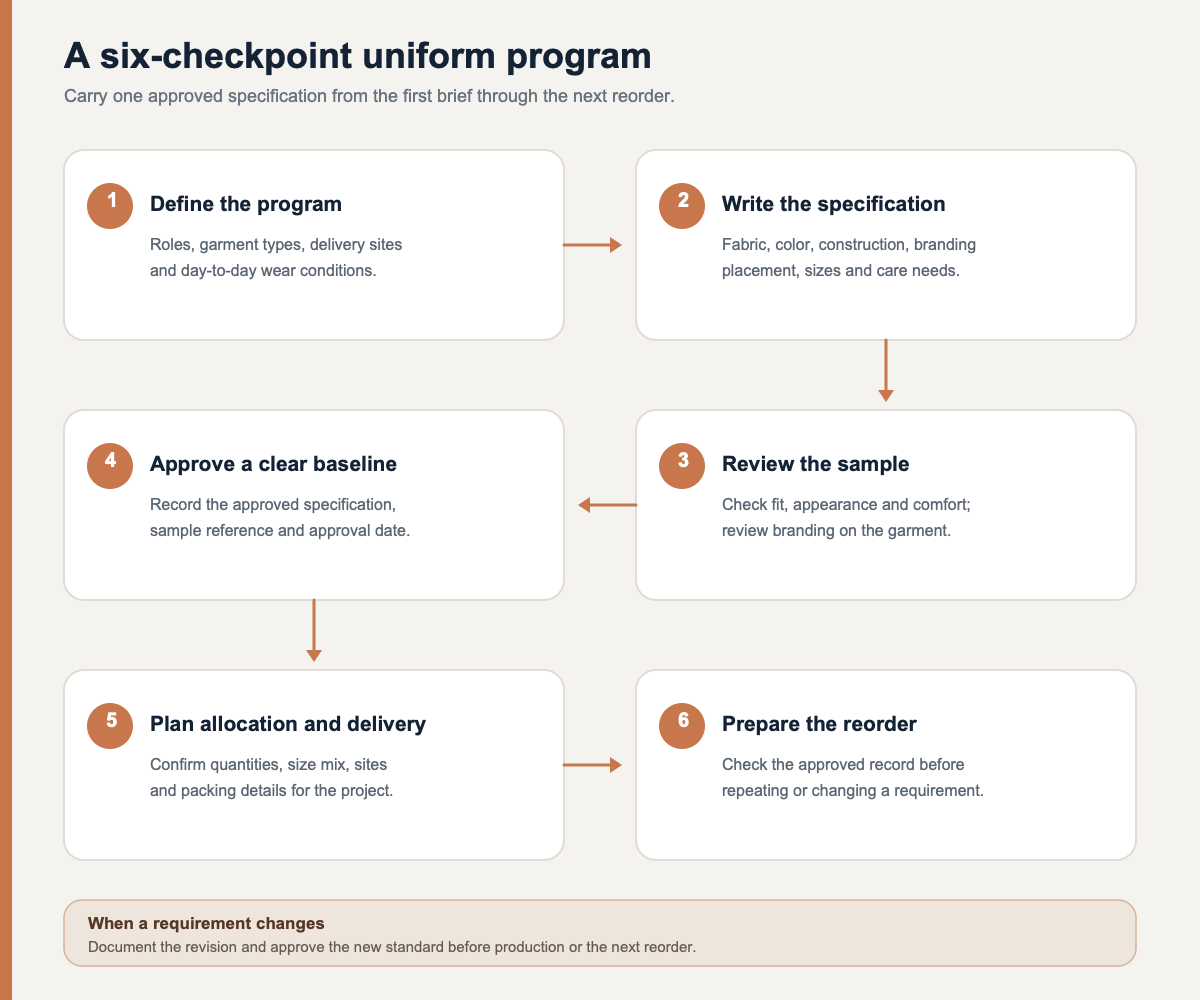
Six checkpoints from brief to reorder
Keep the approved garment specification connected to each project decision.
- 01
Define the program
Roles, garment types, delivery sites and day-to-day wear conditions.
- 02
Write the specification
Fabric, color, construction, branding placement, sizes and care needs.
- 03
Review the sample
Check fit, appearance and comfort; review branding on the garment.
- 04
Approve a clear baseline
Record the approved specification, sample reference and approval date.
- 05
Plan allocation and delivery
Confirm quantities, size mix, sites and packing details for the project.
- 06
Prepare the reorder
Check the approved record before repeating or changing a requirement.
1. Can the supplier understand the full program?
Start with a clear project brief. List the departments and roles to be outfitted, garment types, expected order cycle, delivery locations and target dates. Note which requirements are fixed and which are open to recommendation. Ask the supplier to confirm the scope back to you so gaps are visible before pricing begins.
2. Are material and garment specifications documented?
Ask how the supplier records fabric composition, weight, color, trims, construction details, branding placement and size measurements. If two departments need different garments, keep the requirements separate by style. A written specification gives sourcing, HR and the supplier one reference for review and future reorders.
3. How will the sample be reviewed and approved?
Agree on who reviews fit, appearance, comfort and use conditions. Record requested changes and confirm which sample version is approved for production. Keep a dated reference, including the specification and branding artwork, so later changes do not get confused with the accepted standard.
4. How will sizing work across different roles?
Uniform programs may cover different body shapes, job tasks and work environments. Confirm the available size range, measurement method, fit review process and how employee size information will be collected and protected. Decide who owns final size approval and how late size changes will be handled.
5. Can branding be reviewed at the right stage?
Share approved logo artwork, placement, color and application requirements before sampling. Review branding on the garment, not only on a digital mock-up. If several departments use different marks or colorways, identify each version clearly in the order documents.
6. Are order quantities and project terms clear?
Ask for minimum quantities by style or other relevant ordering unit, sample charges, pricing assumptions and any cost drivers. Confirm what is included in the quote, such as labels, packing, branding or delivery. Terms can differ by garment, quantity and schedule, so request the applicable terms for the specific project instead of relying on a general estimate.
For GAZO projects, the minimum order is 100 pieces. Paid samples are dispatched within 15 days; logo printing and embroidery are paid services. The project quotation states bulk production timing, project pricing and fabric availability. Confirm any additional style or color grouping requirements in the quotation.
7. Is the production and inspection plan understood?
Confirm what must be approved before production starts, how changes are authorized and what checks are performed during the order. Ask what inspection records can be shared and how a quality issue is documented, reviewed and resolved. The goal is a process both sides can follow, not a vague promise of quality.
8. Does the delivery plan match the way uniforms will be issued?
Confirm the production milestones, shipping assumptions, delivery locations and packing instructions. If garments will be distributed by site, department or employee, agree on the information needed for packing and labels. Clarify how schedule changes, partial shipments and delivery updates will be managed.
9. Can the approved program be reordered?
Before the first order closes, agree how specifications, sample references, size details and branding files will be stored. Ask how a future reorder will identify the correct version and how the supplier will flag unavailable materials or requested changes. A repeat order should begin from an agreed reference rather than from memory.
A concise review checklist
- Project scope, roles and delivery locations are documented.
- Garment, material, color, branding and size requirements are recorded.
- Sample comments and the approved version are traceable.
- Quantities, sample policy, pricing assumptions and timing are confirmed for this project.
- Production checks, packing, delivery and reorder records have named owners.
Start with a clear project brief
A useful supplier comparison begins with the same brief, the same review criteria and written answers to open questions. GAZO supports B2B apparel programs through product selection, fabric specification, sampling, size planning, branding and bulk delivery. Share the garment types, team roles, quantity range and target schedule through the project inquiry page. You can also review GAZO’s customization process, hotel uniform and workwear pages while preparing a brief.