
Product, Fabric & Fit Guides
Business Casual Dress Shirts: How to Choose for a Whole Team
Choose business casual dress shirts for a team: compare collars, fabric samples, tucked and untucked lengths, fit options and a clear workplace dress code.
“Business casual” is a short dress code that can produce a very long shopping list. One person buys a crisp white shirt. Another chooses a soft button-down. Both have followed the instruction, but the team may not look as though it belongs together.
For a company, business casual dress shirts work best when the brief defines a few visible details: colour, collar, fit, whether the shirt is tucked in and what it is worn with. Set those boundaries first. Then leave enough room for different bodies and daily tasks.
By ALLEN Jiang · GAZO · 16 October 2026
Decide how formal the working day really is
A shirt for an office-based support team may not need the same presentation as one for a reception team that sometimes wears a jacket. Think about the most common working day, then the occasions when the dress code changes.
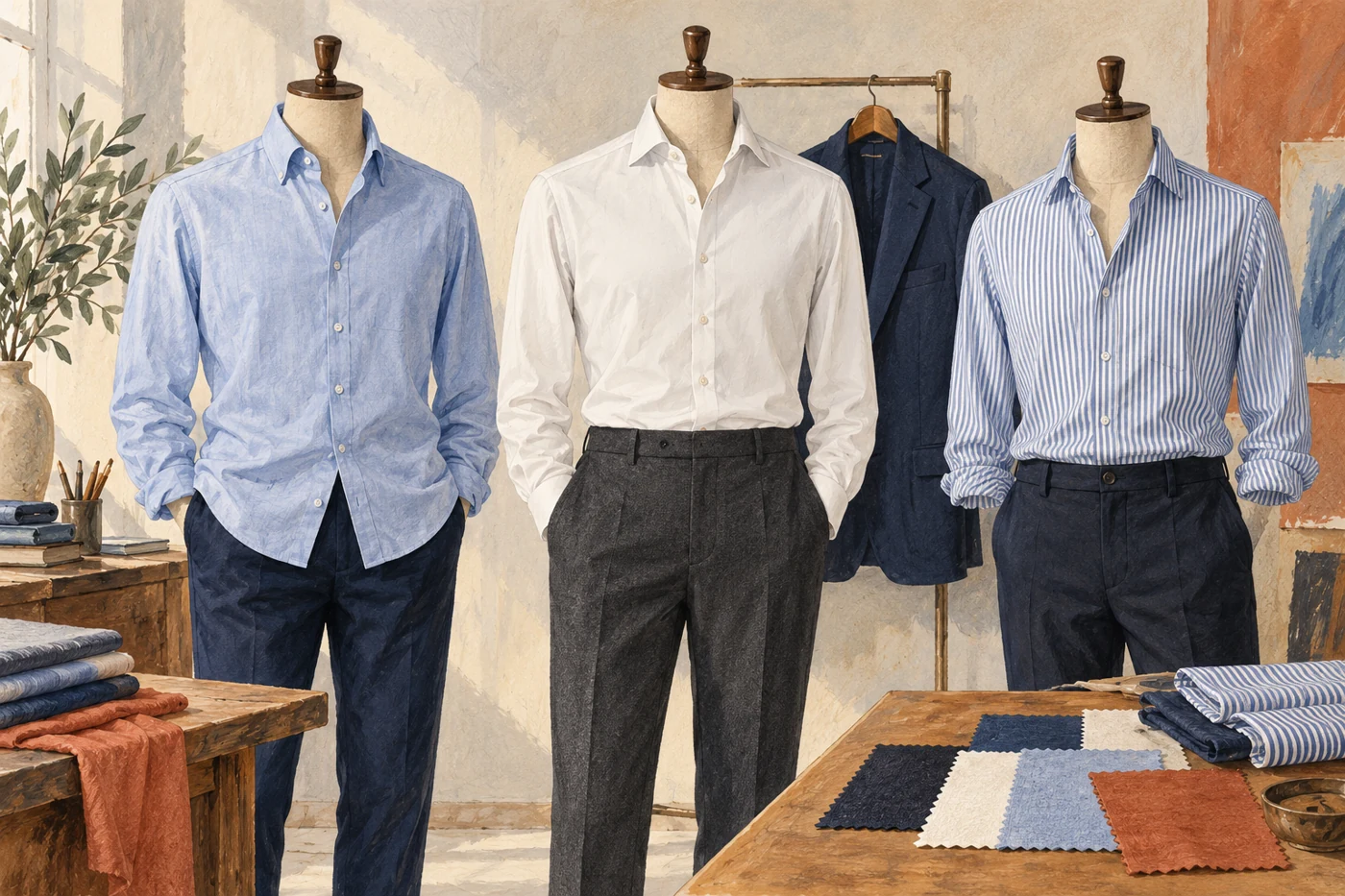
Write a plain-language outfit rule. “Pale-blue shirt, open collar, navy trousers, tucked in; jacket for client meetings” gives people a clearer picture than “smart but approachable”. It also gives a supplier a brief they can quote against.
If employees need two distinct levels of formality, decide whether one shirt can serve both. Try it with the actual jacket and trousers. A second approved shirt may be simpler than trying to make a relaxed style behave like a formal one.
The collar changes the message
Start with the collar worn as it will be worn at work. If the daily dress code is open neck, approve it with the top button open. Look at whether the points sit neatly and whether the collar works with the intended jacket or knitwear.
| Direction | What it brings to the outfit | What to check |
|---|---|---|
| Button-down collar | A visibly relaxed shirt detail | Point position, button spacing and the open-neck shape |
| Semi-spread collar | A restrained option to discuss for shirts worn alone or with tailoring | How the collar sits open and beneath the chosen lapel |
| Wider spread collar | A broader neckline that changes the balance of the shirt front | Appearance without a tie and the height of the collar stand |
These are visual starting points, not universal rules. The pattern, collar construction and wearer all affect the result. A technical drawing is useful; a sample worn with the intended outfit is better.
Compare fabric in the room where it will be worn
Ask for the proposed fabric specification and physical swatches. A smooth poplin, a visible Oxford texture and a twill can give the same blue very different character. The weave name alone does not establish weight, comfort, opacity or wash performance.
Look at a light-coloured sample over the intended underlayer, near a window and under workplace lighting. For a patterned shirt, step back to normal conversation distance. A stripe that looks quiet on a swatch can become the loudest element in the complete outfit.
Ask what “stretch” or “easy care” means for the particular proposal. Request composition and care instructions, then check the sample through the wash and finishing process the team will use. Do not write a blanket promise of crease-free wear into the dress code unless the actual garment has been assessed for your expectations.
Tucked or untucked is a design decision
A long shirt intended to stay tucked can look awkward outside the waistband. A short shirt chosen for untucked wear may come free when the wearer reaches. Decide the wearing rule before approving the body length and hem shape.
Test the length standing, seated and reaching forward. If the shirt is tucked, check whether it stays in place during those movements. If it is untucked, look at the proportion against the trousers and the coverage when the wearer sits.
For teams that allow both, ask whether one style can reasonably serve the rule. Do not assume the same body length suits every height or every wearing preference. Confirm any alternative lengths against the proposed pattern and order terms.
Offer fit choices without losing a shared look
A matching colour does not require identical fit on every employee. Keep the fabric, collar direction and branding consistent, then discuss suitable blocks or size options with the supplier.
Check shoulder position, room across the back, sleeve reach and the button line while seated. A shirt that pulls at the chest may need a different fit rather than more length everywhere. A sleeve that feels right with arms lowered may be restrictive at a keyboard.
Record garment measurements and the agreed fitting method. Use a small fitting group with different proportions before collecting the final size list. Give the people wearing the shirts a private way to flag fit problems; colleagues do not need access to each other’s measurement records.
A small logo needs a proper sample
If the shirt carries a logo, review it on the chosen cloth rather than only on a screen. Colour, scale and placement can change the balance of an otherwise quiet business-casual outfit. Embroidery may also change how the fabric sits around the application, so inspect the area close up and at wearing distance.
Keep the approved artwork, application method, dimensions and placement reference with the shirt specification. If the shirt will also be worn beneath a jacket, check which parts of the mark remain visible. Confirm the charge for logo work in the quotation.
Turn the dress code into a short ordering brief
A good brief fits on one page. It makes the outfit easy to picture and keeps the size list separate from the design decisions.
- Use: office work, reception, sales visits or a combination.
- Outfit: shirt colour, collar direction, trousers and optional layers.
- Wear: open neck or tie; tucked, untucked or a defined choice.
- Cloth: proposed fabric, opacity expectation and intended wash process.
- Fit: garment measurements, fitting group and approval owner.
- Branding: artwork version, method, size and placement.
- Order: quantities by style and size, delivery sites and required date.
Keep the approved sample and this record together for future shirt reorders. Check availability again before repeating the order and approve any material change.
Custom dress shirts from GAZO
GAZO is a B2B corporate clothing manufacturer in Yiwu, China. We recommend shirts and coordinated product combinations by role and department. You can explore our dress shirt range or discuss a custom shirt project using your team’s dress code as the starting point.
Our minimum order is 100 pieces. Paid samples are dispatched within 15 days. Logo printing and embroidery are paid services. The sample dispatch period is separate from transport time. Bulk production timing, price, freight and any style or colour grouping requirements are confirmed in the project quotation.
Send the brief, headcount, quantity by style, logo artwork and required delivery date through the project enquiry form. If the dress code is still just “business casual”, start with three decisions: which blue, which collar and whether the shirt is tucked. Those answers will make the next conversation much more useful.