
Industry Uniforms
Hotel Housekeeping Uniforms: Choose for Movement and Laundry
Plan hotel housekeeping uniforms around reaching, bending and laundry. A practical guide to tunics, trousers, pockets, sample trials and order quantities.
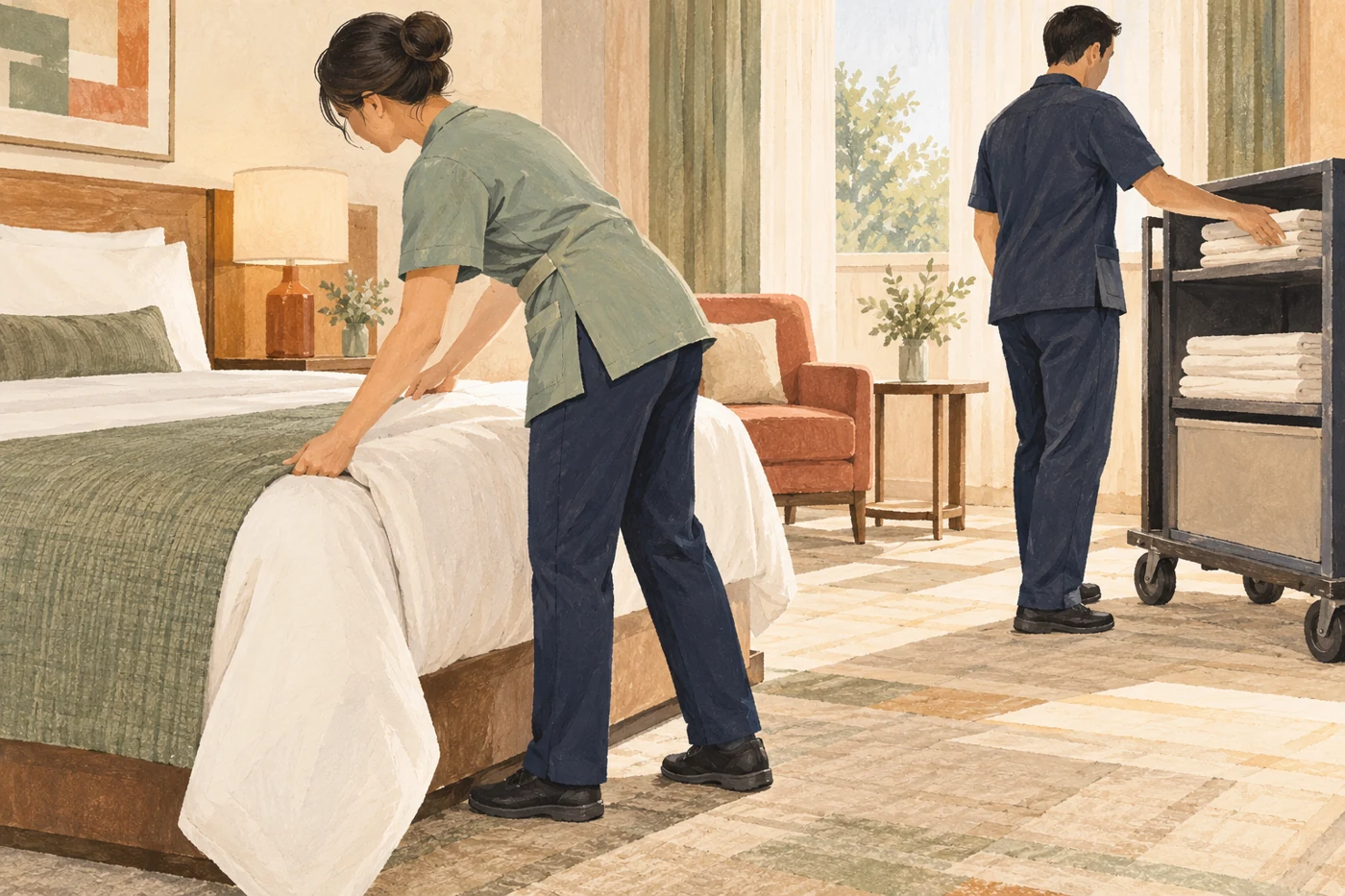
A room attendant bends over beds, reaches across baths and pushes a loaded trolley. A uniform that looks tidy while standing still can pull at the back, catch at the sleeve or drop its pocket contents during those tasks.
Good hotel housekeeping uniforms begin with that movement. Choose the garment combination, check it in the work and put the intended laundry process on the sample brief. Colour and branding come after the team can reach, bend and sit comfortably.
By ALLEN Jiang · GAZO · 16 October 2026
Write the brief around a working room
Ask a room attendant and a housekeeping supervisor to help describe a normal shift. The useful details are specific: which tasks require an overhead reach, where staff kneel or bend, what they carry and how often they move between warm and cool areas.
Keep clothing requirements separate from protective equipment. A standard tunic or work trouser is not proof of protection against cleaning chemicals. Follow the hotel’s task assessment and product instructions for any protective equipment needed; do not infer protection from a fabric name or marketing photograph.
For the clothing brief, capture these five items:
- The tasks and movements the outfit must allow.
- The proposed top, trousers and any optional layers.
- The items staff carry and where they carry them.
- The laundry process and available care conditions.
- The size range and fitting method for the actual team.
Tunic, shirt or separate layers?
A tunic creates a clear housekeeping identity. A shirt and trouser combination may connect the department visually to other hotel teams. Separate layers offer another choice where staff move between different working temperatures. The right answer depends on the tasks, fit and wash trial.
| Option | Useful feature to discuss | Sample check |
|---|---|---|
| Tunic + trousers | Coverage while bending; side opening and sleeve shape | Bend to the bed edge and reach forward without the back pulling |
| Shirt + trousers | A familiar outfit with a clearly defined tucked or untucked policy | Check the hem and waistband after repeated reach-and-bend tasks |
| Top + optional outer layer | A layer for cooler service areas or transitions | Repeat the movement check with both garments worn together |
Choose between these options with the team in the room. A supervisor may prefer a longer top for coverage, while a wearer finds that the same length catches when reaching. That is a sample discussion worth having before quantities are fixed.
Give every pocket a purpose
More pockets are not automatically more useful. Start with the items that genuinely travel with the employee. A key card, small notebook and radio place different demands on depth, closure and position.
Put the expected items in the sample pockets and repeat the work movements. Does an item press into the body when bending? Does a radio pull the top sideways? Can the wearer reach a pocket without twisting? If a closure is proposed, check it with the way the team actually uses the pocket.
Keep cleaning products and heavier equipment on the storage system intended for them. Do not let a roomy uniform pocket become the default answer to every carrying problem.
Check the fabric after your wash process
Two garments with the same broad composition can feel and behave differently because their construction and finish differ. Request the proposed composition, weight, weave or knit construction, finish and care instructions. Compare samples rather than buying from a fibre percentage alone.
Agree a laundry trial within the care instructions and record the cycle used. Mark measurement points before washing, then check the same points afterwards. Look at the seams, neckline, closures, colour and overall appearance alongside the measurements.
If staff would be expected to wear the garment straight from the laundry’s normal finishing process, assess it that way. Hand-pressing a presentation sample tells you little about the workload the hotel will face every week.
Resolve any mismatch between the care label and the laundry operator’s process before approval. If a wash method changes later, treat it as a reason to review the garment again.
A short movement trial that produces useful comments
You do not need a theatrical demonstration. You need a repeatable check on a safe, representative task area. Ask wearers to use the normal equipment and the complete proposed outfit.
- Reach: extend forward and upwards as the job requires. Check sleeve lift and restriction across the back.
- Bend: work at a bed edge. Check coverage, the waistband and the neckline.
- Walk and push: take a normal route with the trolley. Look for rubbing, catching and unwanted garment movement.
- Carry: load only the intended personal items in the pockets and repeat the movements.
- Sit: check the trouser rise, thigh room and closures without adjusting the outfit into an artificial position.
Write down the movement, the sample style and size, and what happened. “The tunic lifts at the back when reaching” is more useful than “too small”. A pattern adjustment and a larger size solve different problems.
Size and quantity need their own plan
Use the supplier’s garment measurements and a consistent fitting process. Ask how alternative fits or lengths can be handled for the proposed styles. Do not assume a larger size will solve every length or movement issue.
Plan quantities by employee issue, laundry turnaround and replacement needs. Keep tops and trousers as separate stock lines, because their size distribution and replacement pattern may differ. An order sheet should identify the exact style, colour, size, quantity and destination for each line.
Before a reorder, bring back the approved specification and sample record. Confirm cloth and colour availability, then record any change. A new fabric under an old style name is still a change the hotel needs to review.
A clear starting point with GAZO
GAZO is a B2B corporate uniform manufacturer in Yiwu, China. We provide product-mix recommendations for hotel departments and discuss shirts, workwear and coordinated garments against the project brief.
Minimum order: 100 pieces. Paid samples are dispatched within 15 days. Logo printing and embroidery are paid services. Sample dispatch timing does not include transport to your hotel. Bulk production timing, price, freight and any style or colour grouping conditions are stated in the project quotation.
To discuss hotel uniforms, send the housekeeping headcount, preferred garments, current fit problems, wash process, logo artwork and required delivery date through the project enquiry form. A photograph of the current outfit can help explain what needs to change. There is no need to pretend the design is finished before asking a practical question.
For a wider department plan, read our hotel employee uniform guide. For a logo on the new garments, use the sample approval checklist.