
Uniform Sourcing & Procurement
How to Order Company Uniforms: A Step-by-Step Rollout Plan for HR and Procurement
A step-by-step guide for HR and procurement: what to prepare, the six ordering steps with a uniform factory, and a five-phase rollout from sizes to reorders.
Quick answer: Order company uniforms in six steps. Define roles and requirements. Get a product mix recommended for each role. Approve a paid sample. Sign off the quotation. Confirm bulk timing. Plan shipping and distribution. Then roll out in phases: collect sizes, pilot with a small group, issue to everyone, and keep a reorder record. GAZO’s minimum is 100 pieces, and paid samples are dispatched within 15 days.
Key takeaways
- Prepare roles, garments per role, pieces per person, brand rules, sites and a launch date.
- Six steps: requirements, product mix by role, paid sample (dispatched within 15 days), quotation, bulk timing, shipping. MOQ is 100 pieces; GAZO normally replies within 1 working day.
- Roll out in phases: collect sizes, pilot, bulk order with quality checks, distribute by site, keep a reorder record.
This guide is for HR, procurement and operations teams introducing or replacing uniforms across a company, from one office to many sites. It covers what to prepare, how the ordering process works with a manufacturer and how to run the rollout so every employee gets the right garment.
6
ordering steps
100
pieces minimum order
15 days
paid sample dispatch
80,000
garments per month capacity
Before you contact a manufacturer
A clear brief gets a faster, more accurate quote. Gather these first:
| Item | What to decide |
|---|---|
| Roles | Which job roles need uniforms, and how many people in each |
| Garments per role | For example shirt and trousers for front desk, suit for managers, workwear for maintenance |
| Pieces per person | How many sets each person needs for a working week |
| Brand rules | Colours, logo files, and where logos and names go |
| Conditions | Indoor, outdoor, seasonal or customer-facing; how garments will be washed |
| Sites and dates | Delivery addresses and the launch date you are working back from |
| Budget owner | Who approves the sample and the quotation |
Industry pages such as hotel uniforms, bank uniforms and retail uniforms show typical role mixes.
Choosing garments by role
The product mix is where a uniform programme succeeds or fails. Start from what each role does all day, not from a catalogue page.
| Role type | Typical garments | What to check |
|---|---|---|
| Front desk and customer-facing | Dress shirts, suits or vests, trousers or skirts | Colour consistency, crease resistance, a smart fit across sizes |
| Managers | Suits, dress shirts, overcoats for winter | Fabric quality and tailoring that sets them apart without breaking the brand |
| Operations and maintenance | Workwear, trousers, jackets | Movement, pockets, durability and frequent washing |
| Outdoor and seasonal | Jackets, down jackets, wool sweaters | Layering, warmth and how logos sit on outerwear |
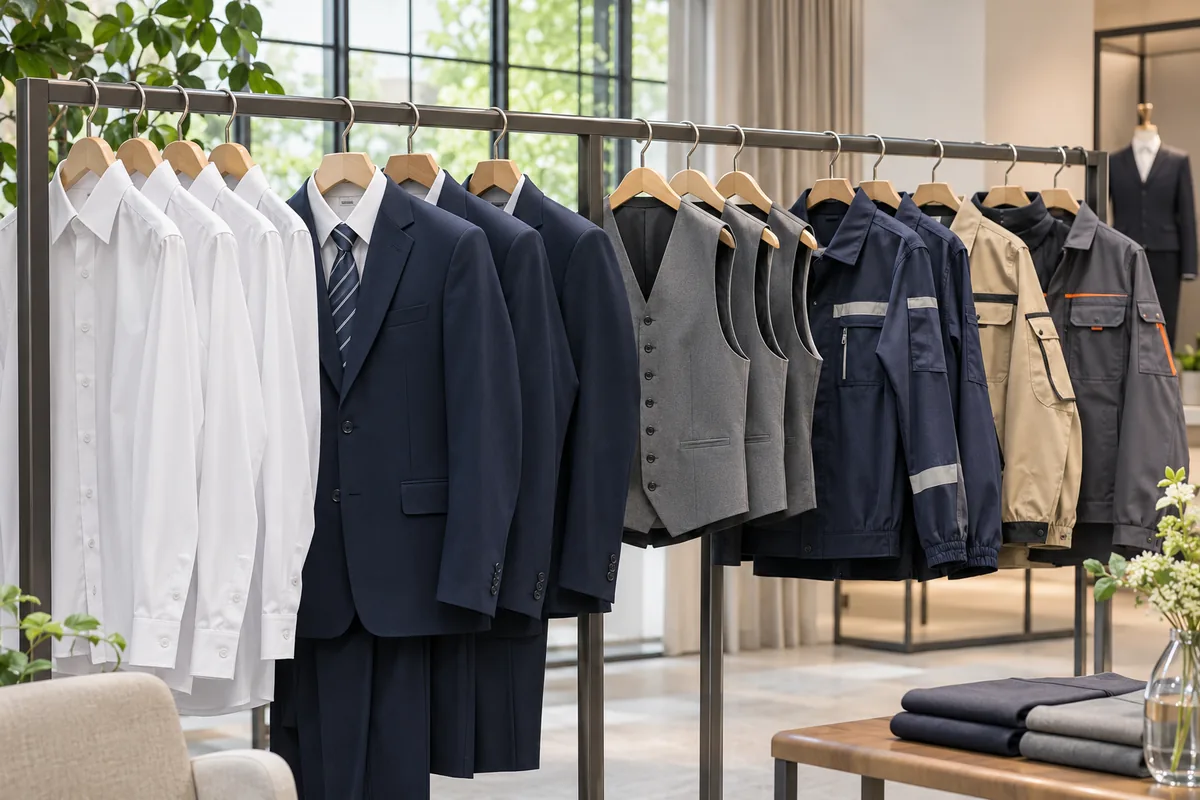
Explore dress shirts, business suits and workwear to see the ranges. Keep colours and logo placement consistent across every garment so the whole team reads as one brand.
How many pieces per person?
Base it on working days and wash cycles. Staff who work five days and wash at home usually need several shirts and fewer jackets or suits. Decide this per role and multiply by headcount, then add a small reserve for new starters and replacements.
The six ordering steps
- Share your requirements. Send roles, quantities, garments and brand rules through the project request.
- Get a product mix by role. GAZO recommends garments for each role from its ranges: dress shirts, suits, workwear, vests, trousers and skirts, wool sweaters, overcoats, jackets and down jackets.
- Approve a paid sample. Samples are dispatched within 15 days. Check fit, colour, fabric and logo on real wearers.
- Sign off the quotation. Logo printing and embroidery are paid services and appear in the quote.
- Confirm bulk timing. Production time is stated in the project quotation, based on the garments and quantity.
- Plan shipping. Shipping method and terms are also set out in the quotation.
Start at project request; the customisation page explains fabric, fit and branding options.

Work backwards from your launch date: sample, approval, production, shipping, distribution.
Rollout plan: from sizes to the first day
Phase 1: collect sizes
Send every employee a short form with role, site and body measurements. Use one method for everyone. A size sheet with wearer codes becomes your master record.
Phase 2: pilot
Issue the approved sample garments to a small group in each role. Ask for feedback on fit, comfort and practicality over a real working week. Adjust sizing or garment choice before bulk.
Phase 3: bulk order and quality checks
Confirm the final size split and quantities. Every garment is inspected against a 28-point quality check before packing.
Phase 4: distribution
Ask for packing by site, department or wearer so garments go straight to the right person. Set an issue date, explain care instructions and collect any exchanges in one round.
Phase 5: reorders and new starters
Keep the size sheet, style codes and approved sample. New starters can then be matched and added to the next order without starting again.

A planning timeline
| Stage | Owner | Timing |
|---|---|---|
| Brief and requirements | HR / procurement | Your schedule |
| Product mix and quotation | GAZO | Normally within 1 working day |
| Paid sample | GAZO | Dispatched within 15 days |
| Pilot and feedback | HR | Allow one working week or more |
| Bulk production | GAZO | As stated in the project quotation |
| Shipping | GAZO / forwarder | As stated in the project quotation |
| Distribution | HR / site managers | Before launch day |
Leave a buffer before launch for exchanges and late starters.
Common mistakes
- Ordering before the pilot. A week of wear finds problems a meeting room cannot.
- One garment for every role. Front desk, back office and maintenance need different things.
- Ignoring care. Choose fabrics that suit how staff will wash them.
- No reorder record. Without it, every new batch risks a colour or size mismatch.
- Late logos. Send final vector artwork with the brief, not after the sample.
Why work directly with a factory
GAZO is a corporate uniform manufacturer in Yiwu, China, with a facility of more than 10,000 m², 200 employees, four shirt lines and two suit lines, and capacity of about 80,000 garments a month. See the factory and the Yiwu supply chain for how materials are sourced.
Comparing suppliers first? Use the corporate uniform supplier checklist, and for suit sizing see the corporate suit fit guide and how to size a team for corporate suits.
FAQ
How do I order uniforms for my company?
Share your roles and requirements, get a product mix by role, approve a paid sample, sign off the quotation, confirm bulk timing and plan shipping. Then roll out in phases.
What is the minimum order?
GAZO’s minimum order is 100 pieces.
How quickly does GAZO reply?
GAZO normally replies with a product mix and quotation within 1 working day of receiving your brief.
How long does a sample take?
Paid samples are dispatched within 15 days.
How long does bulk production take?
Bulk timing depends on the garments and quantity and is stated in the project quotation.
Can you add our logo?
Yes. Logo printing and embroidery are available as paid services.
Which garments can be included?
Dress shirts, suits, workwear, vests, trousers and skirts, wool sweaters, overcoats, jackets and down jackets.
How should we collect employee sizes?
Use one size form for everyone with role, site and body measurements, and keep it as the master record for reorders.
Start your uniform project
Send your roles, quantities and launch date. We normally reply within 1 working day and will recommend a product mix and quote the sample.